
Is the "Accept" Button Obsolete? 5 Surprising Ways Kick is Automating the Ledger
Kick, a modern accounting platform designed as a more automated, AI-driven alternative to traditional software like QuickBooks. A key highlight of the system is its multi-entity architecture, which allows bookkeepers to manage several business units or LLCs under a single client profile with ease.
7/19/20264 min read
For the modern small business owner, the traditional accounting experience has devolved into a battle against "software bloat." Platforms like QuickBooks Online (QBO) have historically anchored the industry in a workflow defined by manual intervention: the repetitive, mind-numbing clicking of the "Accept" button for every single transaction. But as digital transformation accelerates, a new contender called Kick is betting that this manual verification is a relic of the past.
Positioning itself as "self-driving bookkeeping," Kick isn't just an alternative interface; it represents a fundamental shift in the philosophy of the general ledger. By leveraging a high-automation, AI-first architecture, Kick asks a provocative question: Can we finally move from "data entry" to true "exception management"?
1. The Ledger of Record: Why the Bank Feed is the Only Truth
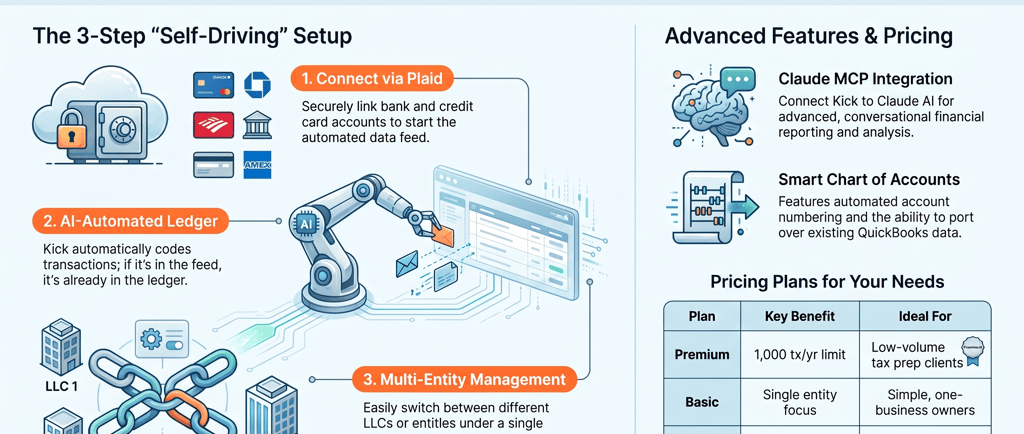
In the traditional accounting world, the bank feed is a staging area—a list of suggestions that don't officially exist in your books until a human grants them permission. Kick flips this script entirely. Its core philosophy is that if a transaction has cleared the bank, it is a factual financial event that should already be part of the ledger.
This "Bank Feed is Truth" approach eliminates the "Accept" button entirely. Transactions flow directly into the ledger, categorized by AI upon arrival. From a strategy perspective, this shifts the bookkeeper’s role from a validator of every transaction to an "exception manager" who only intervenes when the AI’s logic fails.
"Kick is taking the approach that's like if it's in the bank feed, it's a real thing... you tell me to change it if it's wrong basically."
However, this automation introduces a new governance challenge. Because Kick allows for a "Parent Company" structure housing multiple entities, there is a real-world risk of adding a new bank account to the wrong entity profile. In a self-driving environment, such an error can quickly ripple through the books, requiring users to be hyper-aware of their entity-level context.
2. The Serial Entrepreneur’s Command Center: Mastering Multi-Entity Architecture
One of the most persistent pain points for real estate investors and serial entrepreneurs is the friction of managing multiple LLCs. Traditional software typically requires separate logins or subscriptions, leading to the "co-mingling" confusion that haunts tax season. Kick solves this through a unified "Parent Company" architecture.
Under one client profile, users can toggle between various entities (e.g., different rental properties or consulting arms). Because Kick’s AI sees the entire ecosystem at once, it excels at recognizing "Intercompany Transfers." When money moves from a tax savings account in one entity to a checking account in another, the system automatically identifies and matches the transaction. This cross-entity visibility provides a level of clarity that traditionally required hours of manual "due to/due from" reconciliations.
3. The End of the Learning Curve: Zero-Training Categorization and Standardized COA
Most AI-driven tools require a "training" period where the user meticulously teaches the software that "T-Mobile" equals "Communications." Kick aims for immediate utility by providing "best guesses" the moment a bank account is connected via Plaid. It can instantly identify interest income or software subscriptions without a single click of user input.
This automation is supported by a standardized, automatically numbered Chart of Accounts (COA). While this saves the user from the tedious task of designing a numbering system from scratch, it comes with a consultant's caveat: the COA is a "one-size-fits-all" list. Users may find their ledger cluttered with fixed asset or liability accounts they will never use, a trade-off for the speed of an out-of-the-box setup.
Strategic Note on Migration: For those looking to ditch the QBO bloat, it is important to note that migrating an existing Chart of Accounts from QuickBooks is not currently a self-service feature. Moving your historical data into Kick requires a manual "port over" handled by the Kick team, a critical hurdle for firms looking for an instantaneous switch.
4. Beyond Chat: The High-Stakes Potential of the Claude MCP Connection
Perhaps the most technical differentiator for "AI Nerds" is Kick’s integration with Claude AI via the Model Context Protocol (MCP). Unlike basic "chat-with-your-data" wrappers, this is a sophisticated "read-write capability" connection.
This allows Kick to communicate directly with the Claude interface, potentially enabling natural language reporting. Rather than clicking through menus to find a specific P&L variation, a user can query the AI to generate insights or even execute commands directly within the chat interface. This transforms the ledger from a static record into a dynamic, queryable data source, positioning Kick as a pioneer in the "AI-as-the-UI" movement.
5. From Tax-Only Simplicity to Accrual Power: A Tiered Strategy for Efficiency
Kick’s pricing model reveals a clever strategy for capturing the "low-volume" market that traditional software often overcharges.
The Free Tier: Limited to 20 transactions per year, this is a "killer feature" for tax professionals. It allows them to connect a "tax-only" client’s bank accounts and generate accurate financials in seconds, rather than manually reconstructing a year of activity.
The Basic Tier: Targeted at single entities with low monthly volume.
The Plus Tier: This is where Kick becomes a robust QuickBooks alternative. The "Plus" tier unlocks multi-entity management, departments, locations, and—crucially—accrual-based accounting.
"I think that Kick is like a fantastic thing... you could just like connect to their bank accounts, you know get financials in seconds."
Conclusion: The Future of the "AI Nerd" Accountant
Kick represents a decisive move away from the "manual verification" era of bookkeeping and toward a model of automated confidence. By treating the bank feed as the ledger and integrating deep AI protocols like MCP, it offers a vision of the future where the software—not the human—is responsible for the heavy lifting of categorization.
As the industry moves toward these "self-driving" solutions, the ultimate question for practitioners and business owners remains: Are you ready to relinquish the illusion of control provided by the "Accept" button in exchange for the radical speed of a bank-feed-is-truth ledger?
Services
Expert bookkeeping for small businesses and accounting firms.
Contact
Support
info@virtualledgerhub.com
© 2025. All rights reserved.